I was founding staff in a pioneering effort to mobilize people’s collective power for peace. Our effort gave birth to the United Religions Initiative (URI), a worldwide network of grassroots people from diverse religions and spiritual traditions working for peace. After 25+ years serving in organizational development, I most value the inner personal growth required – my own capacity to endure the turmoil and deepen in love.
Early Years
The first sentence of URI’s Preamble reads:
We, people of diverse religions, spiritual expressions and indigenous traditions throughout the world, establish the United Religions Initiative to promote enduring, daily interfaith cooperation, to end religiously motivated violence and to create cultures of peace, justice and healing for the Earth and all living beings.
I’ve learned to see the prescience of the word enduring in this purpose statement and the incredible ways it opens doors for learning.
In URI’s founding years, hundreds of people from diverse countries, ages, occupations, cultures, religions and spiritual traditions gathered to dream and design an international organization to mobilize collective power of people at the grassroots. We were bound for a world where peace, justice, and healing prevailed.
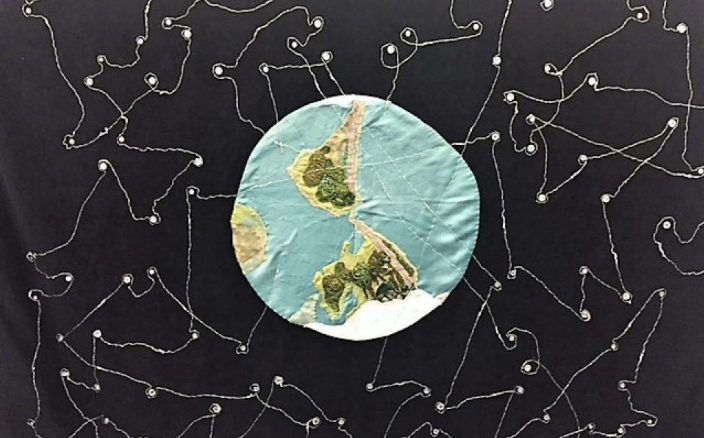
We imagined groups clustering like stars. Each cluster shines brightly, a unique jewel. Jewels intersect and form a brilliant web of connection and grow in collective strength. A Buddhist sutra, Indra’s Net lit us up:
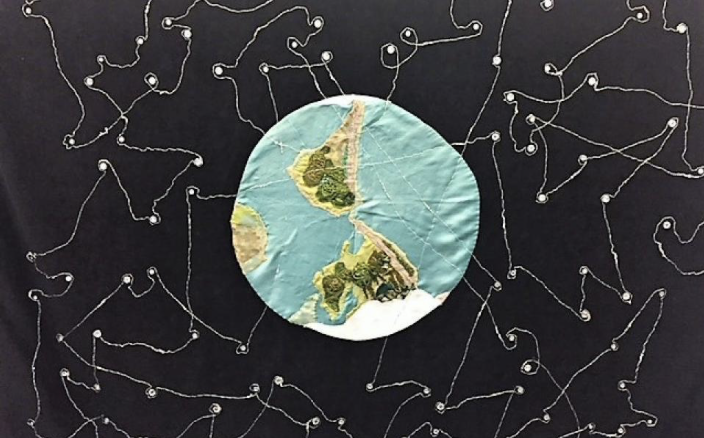
Fabric art – vision of URI’s network of groups each shining their own light and lighting up one another. Art by Louise Todd Cope, 2000.
“There is a cosmic web of interrelatedness extending infinitely in all directions of the universe. Every intersection of the web has a glistening jewel in which all parts of the whole are reflected. Imagine such an organization composed of reflections that endlessly amplify everyone’s strengths, sparkling and glistening.”
Questions burned within us. What if people across the planet used the wisdom of diverse religious and spiritual traditions to work together for peace and justice? Could ordinary people, self-organizing and connecting as a global network, bridge hostility and ignorance among religions and cultures while they worked locally for the common good? What if the collective action of people everywhere grew into an unprecedented global community capable of “turning the world upside down”?
In 1996, our small staff jumped into the wild blue yonder. We were novices in the field of global organizing and most of us knew very little about the practices and beliefs of different religions and spiritual traditions. Three global summit meetings were held at Stanford University that brought together hundreds of leaders from different countries, religions, and varied social sectors. Meeting one another for the first time, we became united in our yearning to ignite the resourcefulness of diverse people to cooperate for a better world.
We were guided by the vision of the Rt. Reverend William Swing, Bishop of California; the leadership of Reverend Charles Gibbs, URI’s founding Executive Director; the organizational expertise of Dr. David Cooperidder and his graduate students from Case University School of Business; Dr. Diana Whitney, CEO Corporation for Positive Change; and Dee Hock, author of Birth of the Chaordic Age. Countless people contributed to URI’s foundational Charter and organizational design. URI’s venture in collective global organizing for peace was an exuberant experiment – exciting and uncharted.
“Could ordinary people, self-organizing and connecting as a global network, bridge hostility and ignorance among religions and cultures while they worked locally for the common good?”
URI officially launched in 2000 with over 70 self-organizing member groups called Cooperation Circles (CCs), creating a global network. They were united by the URI Charter, including a Preamble, Purpose and 21 Principles (PPPs) that grounded and guided their work. Each group decided their own respective name and, with the minimum requirement of at least three people from different religions or traditions, initiated their own activities in pursuit of URI’s purpose. We wanted this work to outlive other NGO start ups. It needed to be carried forward into future generations. We couldn’t guess the extent to which endurance would be required.
In the following decades, over 1200 CCs from over 105 countries joined URI’s global network; a Global Council elected by the CCs took on NGO responsibilities; funding was secured and staff increased across the world. We built the plane while flying it. We experienced what held us together as a community and what debilitated us. We succeeded and tumbled. In the face of relentless violence of all kinds, environmental catastrophes, and escalating assaults on peace across the world, URI chose to commit for the long haul. How would this effort endure? We were challenged to recognize and even embrace ongoing learning edges: our organizational design had built-in tensions; colleagues held conflicting values; we were too busy to give attention to personal growth; peace work in the world meant confronting relentless violence and injustice.
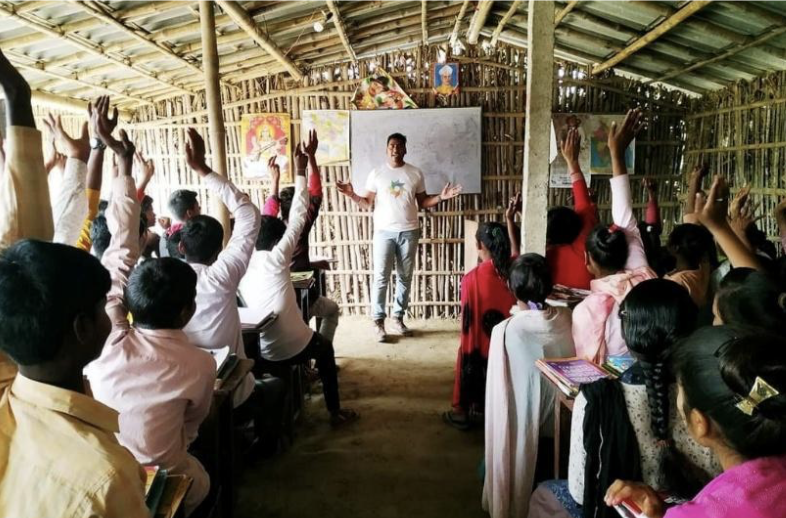
Deepak Kumar, Smiles for Millions CC in Bihar State, East India engages young adults in community organizing.
Enduring the tension
What does it mean to endure? The dictionary tells us that to endure means to last and persist over time without giving way. Endurance signifies the ability or strength to continue despite fatigue or stress.
Marilyn King, a former Olympian who trains young adults in peace building, teaches that Olympians and peace leaders are alike – they both must train for endurance.
URI experimented with an organizational design that relied on distributed authority given to the CCs to fulfill URI’s core Purpose. This dynamic design created a built-in tension between the freedom of CC’s to “do their own thing,” and the CC’s role of responsibly belonging to a global network. URI endorsed locally relevant peacebuilding initiatives by ordinary people. We prized local know-how. At the same time, URI valued holding CCs to a standard of accountability. We wanted to provide CCs with knowledge and training needed to help them succeed and increase impact.
The need to supervise regional staff, develop programs to build the skills of CC members, to assess the impact of URI’s network accomplishments was in tension with our intention to trust people closest to the problem to come up with best solutions; to learn from and build on ideas coming from the CCs.
This built-in organizational tension became acutely personal and led to a painful conflict with a colleague. At the time, I felt I knew that I was right and another staff person was wrong in what kind of materials to provide for new CCs. Our difference of opinion caused anger and mistrust, hurting a good friendship. One day during a meditative opening to a meeting, I heard a voice inside me say, “Sally, don’t you know that loving is more important than being right?” What! My first reaction was irritation, “no, I don’t know that – I know I am right and she is wrong.” In time, I realized that this “voice” was urging me to change, to shift my defensive reactions, to go deeper inside myself. In time, I realized that putting respect and appreciation for the person with whom I disagreed was more important than holding fast to my opinion. My respect for her viewpoint did not make my opinion wrong. Both of our approaches could work thoughtfully and creatively together. For the long haul, our good relationship was more important!
It took a while, but I changed from dismissing that inner voice to wanting to learn how to put relationships uppermost in my work. I realized it was necessary for us as staff of a growing global community to take relationship-building seriously. It would not happen without awareness, intention and practice. I needed to change my ways, to have the courage to resolve conflicts with fellow staff. Global organizing takes personal work! Alongside the hope and excitement of fulfilling URI’s vision was the need for enduring, daily inner work, rooted in courage.
Heart-courage: a kind of love
Enduring learning pangs; navigating inevitable tensions; confronting unmet goals, meeting unrelenting violence with resilient, joyful energy takes incredible personal and spiritual power. I think the source of this power is a kind of Love – it is experiencing the courage of our hearts. Building collective networks for peace takes heart-courage. We need heart-courage to keep at it no matter what assails our efforts. As complexity and dangers increase, what simplicity can guide us? I suggest heart-courage grounded in inner strength and trustworthy relationships. I invite each of us to pay attention to what gives us heart-courage.
“Building collective networks for peace takes heart-courage. We need heart-courage to keep at it no matter what assails our efforts.”
When I witness the good in people from all parts of the world, self-organizing and seeing themselves as vital members of a global community that cares for the whole planet, my endurance and love fire up. My heart courage takes a leap.
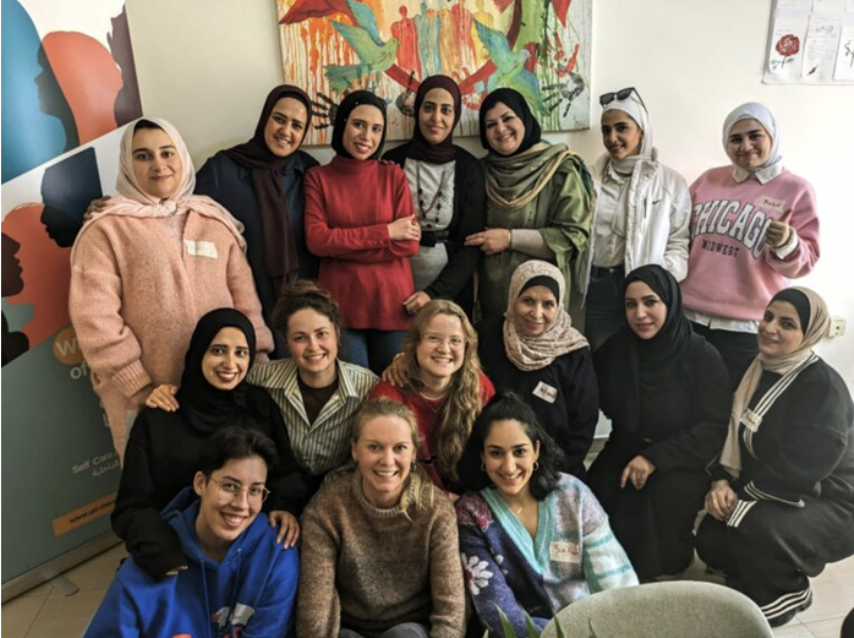
Resilience and Inner Strength Training Workshop led by URI MENA Regional Office, Jordan