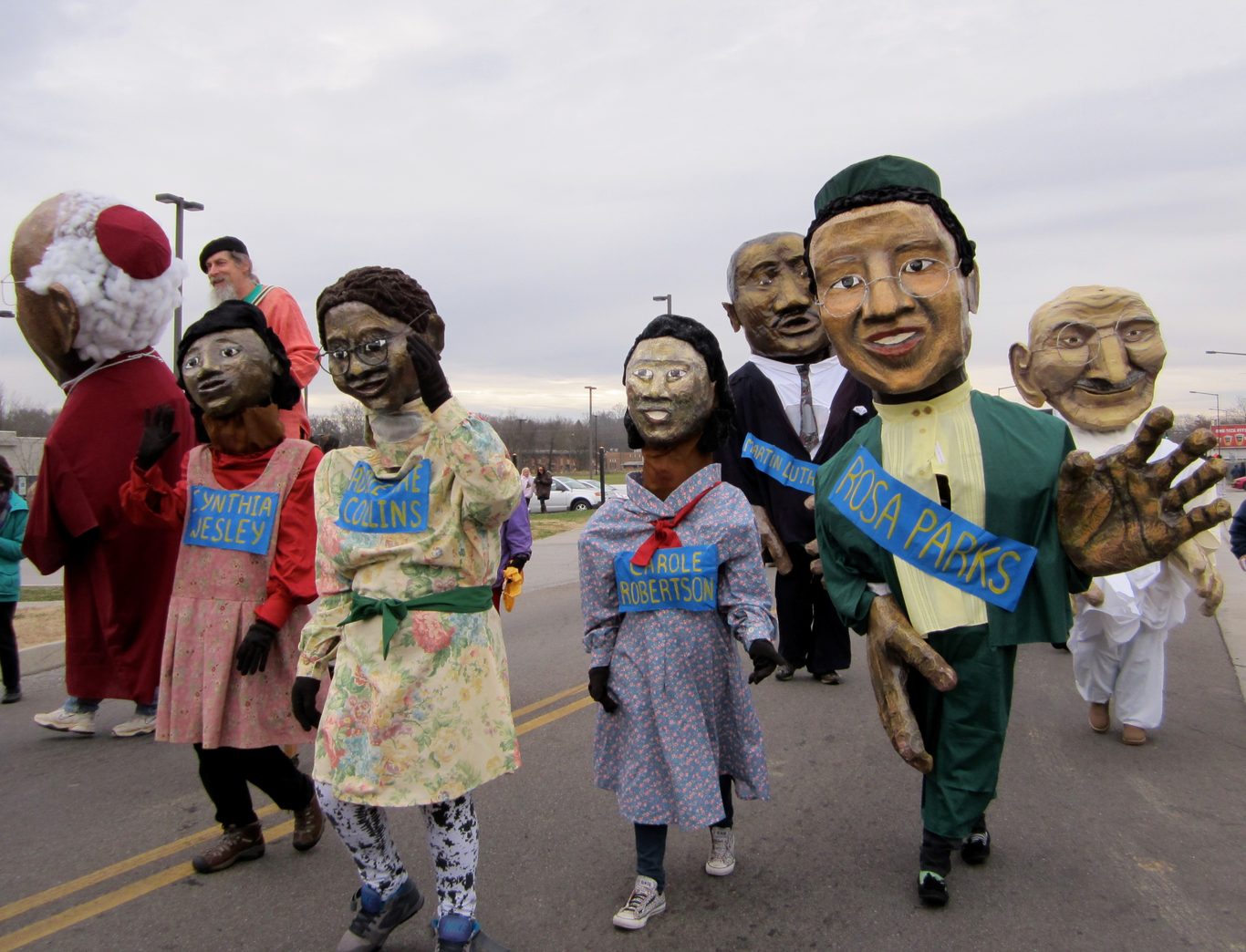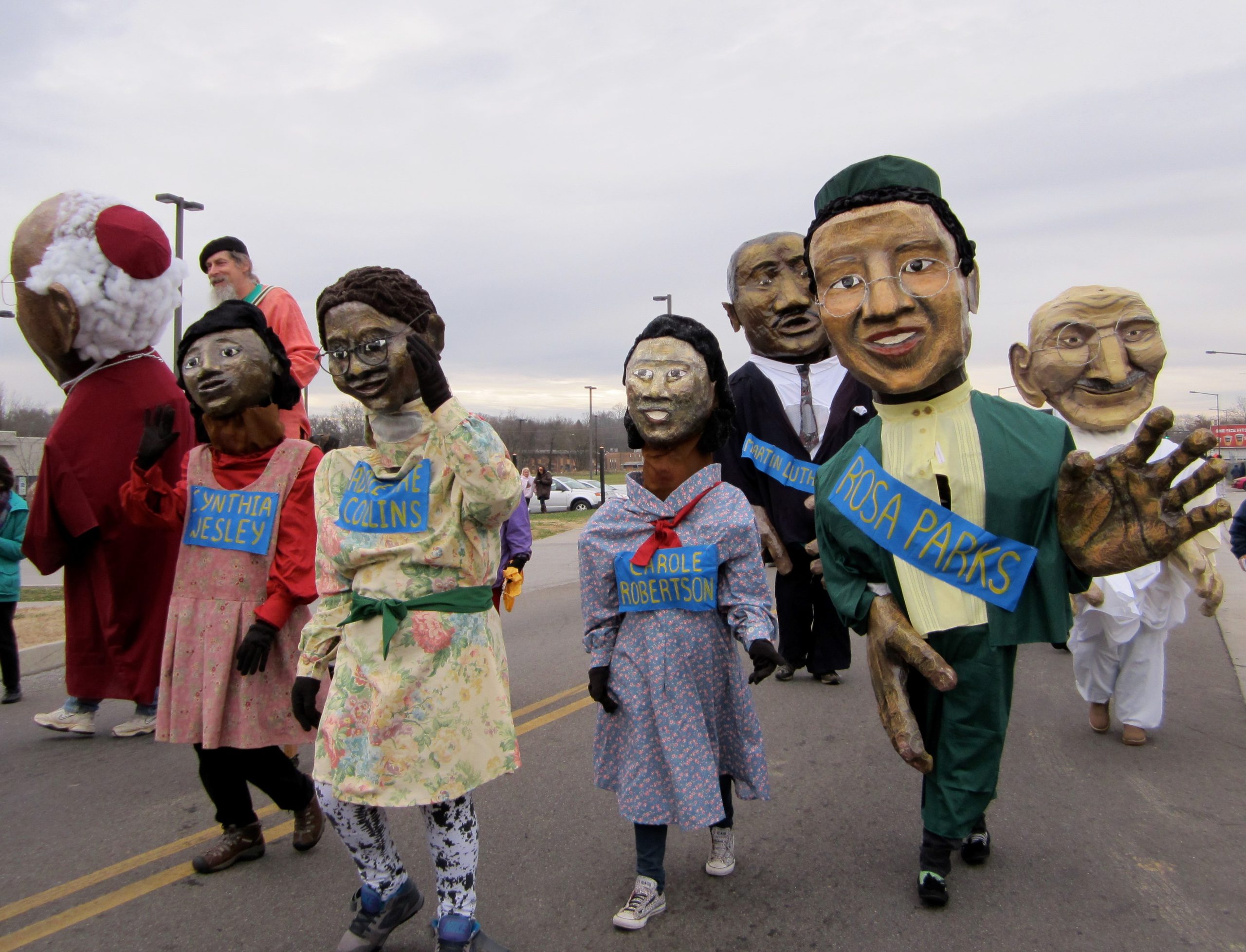
Megapuppets in MLK Day parade, Knoxville, TN. Photo by Ralph Hutchison. Used by permission.
To the reader:
I have written herein some autobiographical essays in the form of letters ostensibly written to my adult children explaining some of the experiences they had while growing up. Within these letters, I have tried to correlate collective action with collective power aimed toward creating a more peaceful planet. This article is an arts-based research project using both creative writing (Leavy, 2018) and autobiography (Bartleet, 2013). I also write with the backdrop of our current No Kings protests when international masses gather where sometimes the turnout for our own civil actions was very limited. Collectivity matters.
Following the 9/11 tragedies, we—me, my wife, and two children—rather than being incapacitated by terror, became activated toward collective action. We began protesting and working with other activists. This activism eventually led to combining my musical and artistic abilities to creative activism, performing social critique through art, especially that of megapuppetry—giant, performing puppets (Bell, 2007)—which has become our activist stock-in-trade.
Dear ____ and _____,
I’ve been reflecting on some of your growing-up experiences—since you’re both adults now—and suspect that some explanation may be in order. So, I’m going to write a series of letters, epistles if you will, maybe clarifying and/or justifying some of those times which were both instructive and experiential. I’m not really apologizing for our parental choices but acknowledging that some of what you experienced may be a struggle for you as you continue to grow. Perhaps I’m being self-indulgent in my rationalization or perhaps I’m striving for parental redemption.
Where do I start? I have to begin with how I understand the collective as being entangled through intra-connectivity. Intra-connectivity comes from agential realism philosophy which is rooted in quantum theory (Barad, 2007)—at which you may groan and roll your eyes. One of the essential ideas of quantum theory is the notion of entanglement (Barad, 2007; Wendt, 2015). The nature of reality is to be entangled in a nebulous, non-definable existence until observable happenstance occurs. If you remember the light-slit experiment from home-school science (Wendt, 2015), it suggests that light is both wave and particle. But the essence of light is both until the experiment happens. Before the experiment, it is both and neither, that is, light is undefinable. This entanglement is a non-definable essence of everything. This notion of entanglement informs my understanding of collectivity (Barad, 2007; Wendt, 2015). Given entanglement as the nature of all reality, then everything retains this nebulous sense of inseparability, a sense that we are collectively all part of the same reality.
If we can begin to think in terms of intra-connection, we are forced to begin living our lives as if what we do individually matters to the whole (Barad, 2007). To use this concept is a powerful mandate toward how we live together. And the mandate of living together, intra-connectedly, moves living together towards greater peace, justice, and well-being of all reality.
And this idea is my beginning point of collective action, protest, and community building. To ignore it is to ignore the essence of all that we are, diminishing our lives and our being.
And I’ll close with that in the hope that you may begin to understand and apply the concepts to how you relate to your respective worlds.
Your doting, intra-connected, papa.
Dear ____ and _____,
Once again, I take pen in hand to follow up on this project. I hope I made sense trying to explain how I think we’re all connected, and so it matters what we do—and in the doing, to behave as if it matters, as if our actions could lead to a better, more peaceful world. This is the basis for doing some of the things we’ve done.
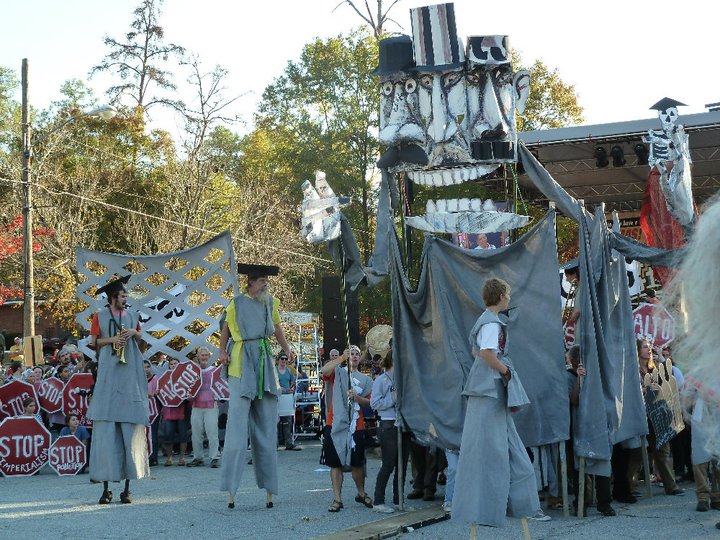
I know you remember going to Fort Benning/Columbus, Georgia for so many years for the School of the Americas Watch (SOAW) rallies. And spending a week or more sleeping on the floor or dumpster diving for food and cardboard for the puppetista pageants. Do you remember George and Bunny Man and performing megapuppet pageants in front of thousands, and dancing on stilts to drumbeats in the pouring rain with giant butterfly wings? Or the large military-industrial monster that collapsed on cue?
We went and continued going at my instigation. I based it on my “calling,” my theological background, leaving my divinity degree with a penchant for Liberation Theology and its preferential option for the poor (Gutierrez, 1983, 1988). The SOAW protests against the Western Hemisphere Institute for Security Cooperation (WHINSEC) training Latin American military and overall US policy in Latin America—this was an opportunity for me to exercise that belief system and to set an example for both of you, hoping to be a model for you to live by. Liberation Theology was a community-based, people-based movement based in theology (Gutierrez, 1988). It was revolutionary in its empowerment of the poorest and the disenfranchised. The SOAW protests became a national symbol to address oppression (Gill, 2004). You may not know, but by the time SOAW moved the protests to Arizona in 2016, WHINSEC was training ICE and CBP officers as well (Gonzalez & Shahshahani, 2019)—which I believe has played into the current ICE/CBP violence against immigrants and citizens alike. I think the leaders may have learned many of their lessons at WHINSEC because they resemble the oppression by Latin American government forces trained at WHINSEC.
I digress. The thousands of people who attended SOAW rallies came from all over the Americas (Gill, 2004). The voices of ten thousand people raised simultaneously still send chills down my back. There was power present there. And the government responded in kind. They razed the vacant apartments where we gathered (Voss, 2019). They installed chain link fences around the gathering for control. They infiltrated our activities (Verheyden-Hilliard, n.d.). They used loudspeakers and helicopters and photography to try to intimidate us. But our collective voices continued.
And the puppet build where we were brought folks from all over the US and Canada for a purpose—to seek peace through policy change through collective, creative activism. We built our pageants to tell stories of oppression with the hope for better futures, whether commemorating the El Mozote massacre with puppets of all the victims or acknowledging Columbus’ European invasion with a Spanish galleon equipped with a steamroller. The stories encompassed the historical violence and oppression enacted against Latin America. But we always tried to end with a vision of hope through drumming, dancing, and music: the collective voices of people calling for justice and peace.
For me, as your papa, I hoped to instill not only a sense of the world but also the sense that in conjunction with others of like mind, you could be empowered to be changemakers. The puppets became my/our voice. We combined speech and music with visual performance to act and advocate. I wanted to empower you to act toward a better world. I hope that those memories have stayed with you as a time of growth, experience, and enlightenment.
Your loving puppetista papa
Dear ____ and _____,
I know you remember our trip to Palestine’s West Bank. We did circus and puppets and music and performance in Bethlehem Square, olive groves, refugee camps, a school for the blind, and the dividing wall (Zreneh, 2008). We got to learn firsthand about the oppression of Palestinians by the state of Israel, supported by the US—which is even more pertinent in the present climate. _________, you’ve almost finished Chomsky’s (1999) Fateful Triangle which lays out the historical context much better than I could ever do.
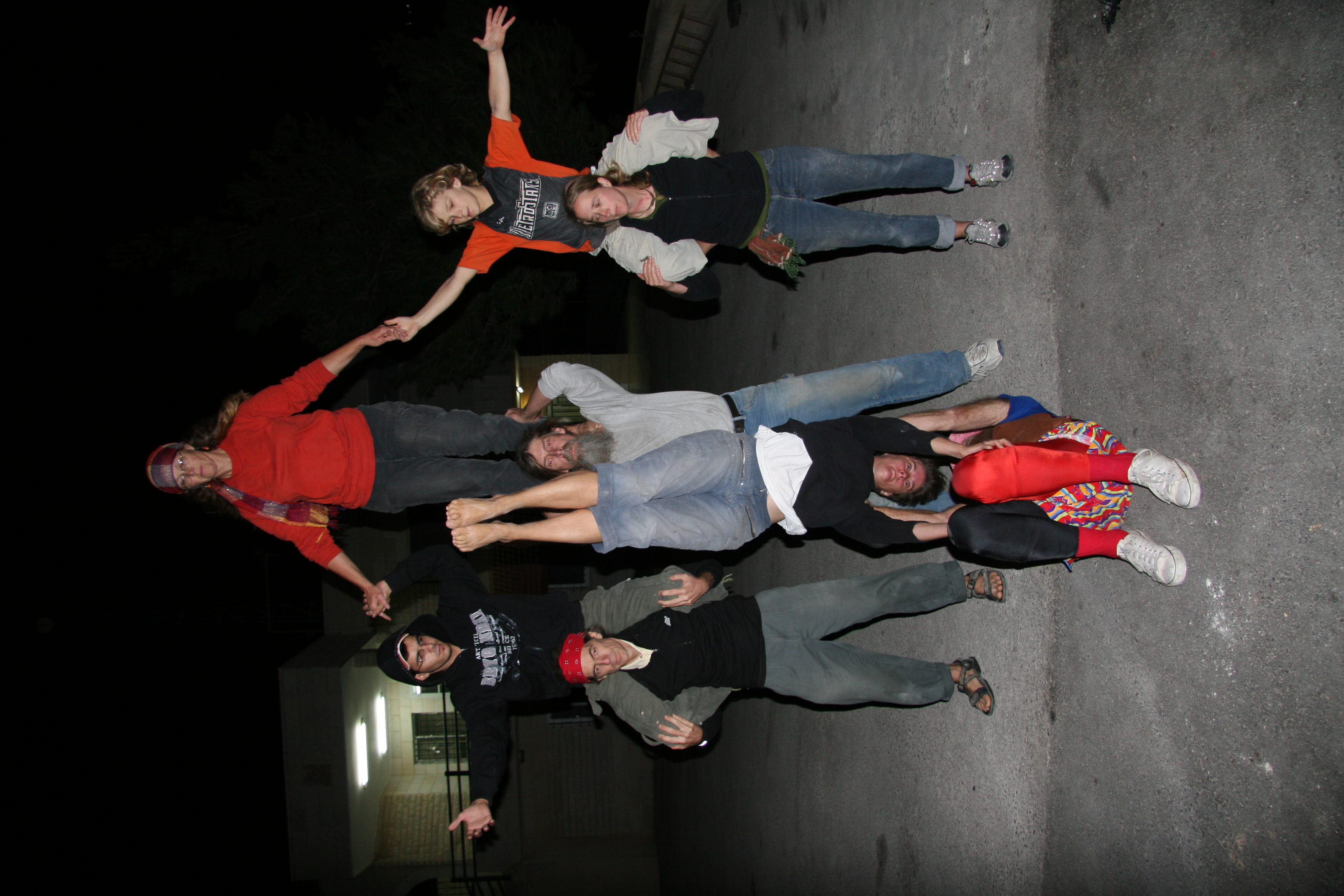
But to back up a bit. We formed a collective out of Knoxville and invited several of our SOAW puppetista counterparts to collaborate in the planning, promotion, and performance (Zreneh, 2008). We were the Olive Tree Circus. Our intention was to experience the Palestinian situation and bring it back to the States as witness to oppression and calling for policy shift toward Palestinians.
Your mom and I debated for many weeks whether to include you two as pre-teens. We consulted friends and experts, Palestinian nationals. We studied the situation and its inherent violence (Chomsky, 1999). Finally, we decided that the opportunity for you was too great to pass up, even understanding the risks involved, because we were not going to be typical tourists—we were seekers for truth. To take you with us meant heightened awareness—it wasn’t just ourselves we were risking, but you all, too. But the chance to see the real story of the West Bank overrode the risks.
You remember the permaculture farm where we rehearsed and lived (Zreneh, 2008). You remember picking olives—going up with the Palestinian farmers so that they would be allowed to reap their harvest. You remember picking olives on stilts and the hassle of
checkpoints. You remember stopping late evening by the olive oil factory and helping squeeze olives. You remember walking down to the corner store by yourselves, in safety, overwatched by the Palestinian community. You remember the fear of IDF soldiers and the Israeli settlers, both heavily armed. You remember Bi’lin when you stayed in town and I went to the protest and played accordion through tear gas and rubber bullets.
We did all those things to exemplify solidarity with Palestinians; to show them that not all US citizens bought into the myth of Israeli superiority (Zreneh, 2008). And we also learned that not all Israelis bought into the Zionist mythology. Through our creative activist performances, we advocated for a better world in which coexistence with others is possible.
This is why we did what we did; this is why we took you with us. We always tried to exemplify family solidarity and by extension, in the West Bank, to demonstrate our international understanding of that same solidarity.
I know this was a formative experience which was by intent. I suspect that you experienced some trauma which was not intended. In our self-exposure to that oppression, we were empowering ourselves to speak collectively to help create a better world. I hope that in time you may understand better.
Love your accordionista papa.
Dear ____ and _____,
There have been more activist adventures that we shared such as the nuclear abolition movement with OREPA and mountaintop removal and environmental activism and education.
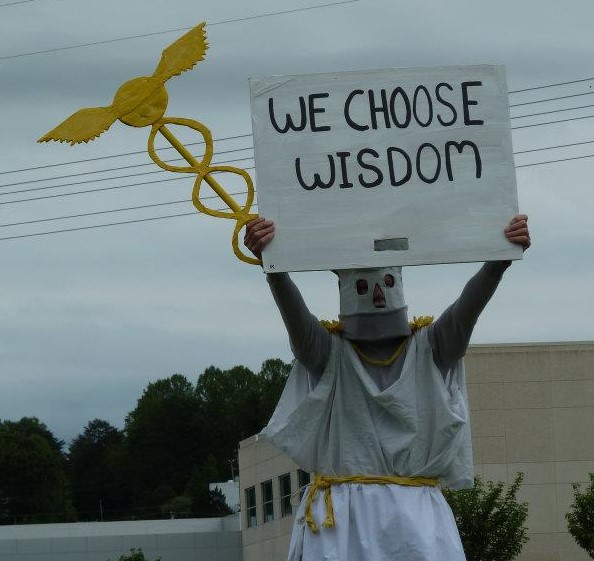
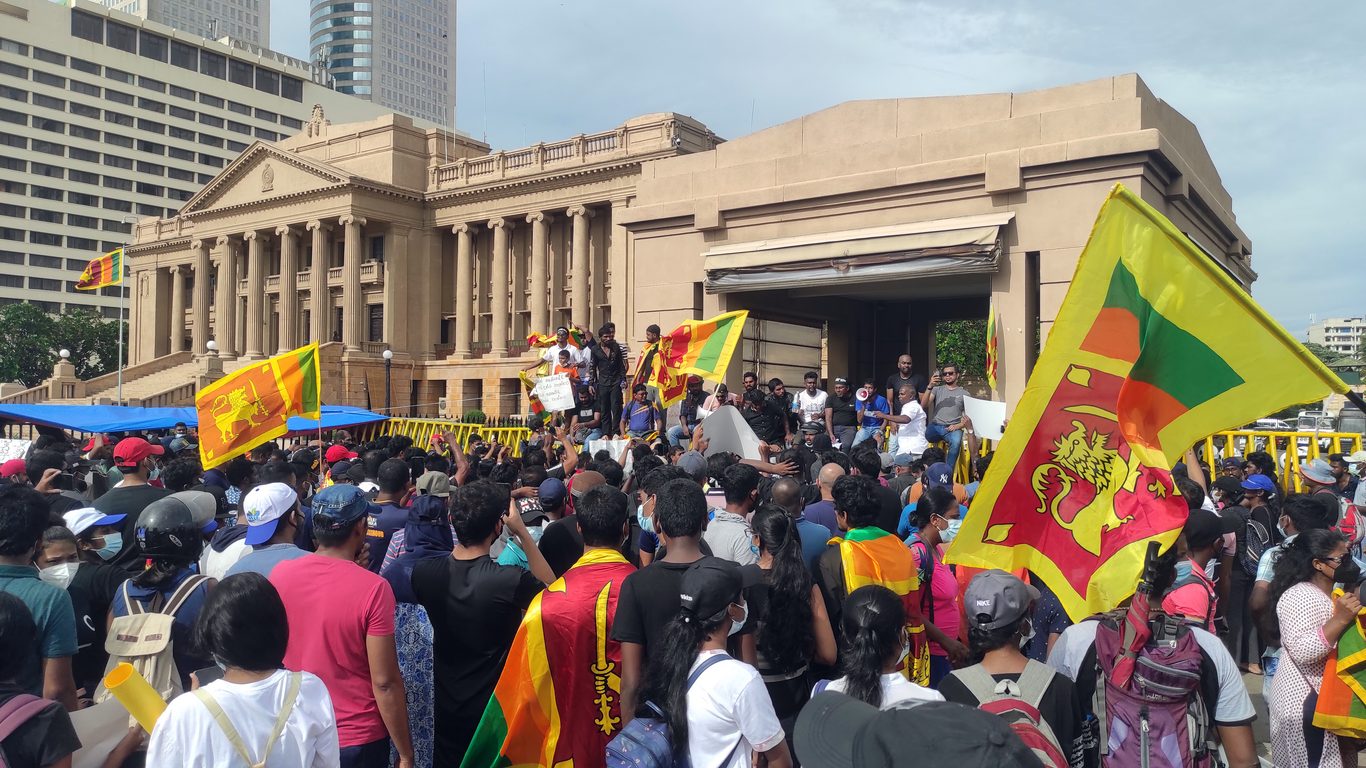
Perhaps our individual actions, little protests, and creative activism have mattered little or brought about little change in the bigger picture. Yet when I see the millions of people uniting in No Kings protests, I am reminded that we were there, protesting the Iraq war after 9/11 when few people came out. We were there bearing witness to nuclear destruction when no one was paying attention. We held the place for peaceful, nonviolent protest and action for times like these when the voice of the people collectively shout for peace. These things do matter, then and now. I will continue writing about them. For now, though, I will close.
Papa.
REFERENCES
Barad, K. (2007). Meeting the universe halfway: Quantum physics and the entanglement of matter and meaning. Duke University Press. https://smartnightreadingroom.files.wordpress.com/2013/05/meeting-the-universe-halfway.pdf
Barone, T. (2008). Going public with arts-inspired social research: Issues of audience. In J. G. Knowles & A. L. Cole (Eds.), Handbook of the arts in qualitative research: Perspectives, methodologies, examples, and issues (pp. 485–492). SAGE Publications.
Bartleet, B-L. (2013). Artful and embodied methods, modes of inquiry, and forms of representation. In S. Holman Jones, T. E. Adams, & C. Ellis (Eds.), Handbook of autoethnography (pp. 443–464). Left Coast Press.
Bell, J. (2007). Mega-puppets and global culture. Puppetry International, 22, n. p. https://www.unima-usa.org/pi-22
Chomsky, N. (1999). Fateful triangle: The United States, Israel, and the Palestinians (Updated edition). Pluto Press.
Gill, L. (2004). The School of the Americas: Military training and political violence in the Americas. Duke University Press.
Gonzalez, D., & Shashahni, A. (2019, November 15). Shut down the School of the Americas/WHINSEC. Jacobin. https://jacobin.com/2019/11/shut-down-school-of-the-americas-whinsec-ice-border-patrol
Gutierrez, G. (1983). The power of the poor in history (R. R. Barr, Trans.). Orbis Books.
Gutierrez, G. (1988). A theology of liberation: History, politics, and salvation (Revised ed.; C. Inda & J. Eagleson, Trans. & Eds.). Orbis Books.
Leavy, P. (2018). Introduction to arts-based research. In P. Leavy (Ed.), Handbook of arts-based research (pp. 3–21). Guilford Press.
Verheyden-Hilliard, M. (n.d.). Exposed: FBI surveillance of School of the Americas Watch. Partnership for Civil Justice Fund. https://www.justiceonline.org/soaw
Wendt, A. (2015). Quantum mind and social science: Unifying physical and social ontology. Cambridge University Press.
Zreneh, J. (2008, November 18). Olive Tree Circus [Video]. YouTube. https://youtu.be/fWgilmmbj74