Movements for peace and democracy in the United States are being tested in new ways. As headlines accelerate and crises overlap, many are asking what is happening, and, perhaps more importantly, what is required of us now? Beneath the noise, some quieter questions are emerging. How do we rebuild the collective muscles needed to meet this moment together? What does it actually take to move forward in practice? How do we embrace our interconnectedness to ensure collective peace sustains?
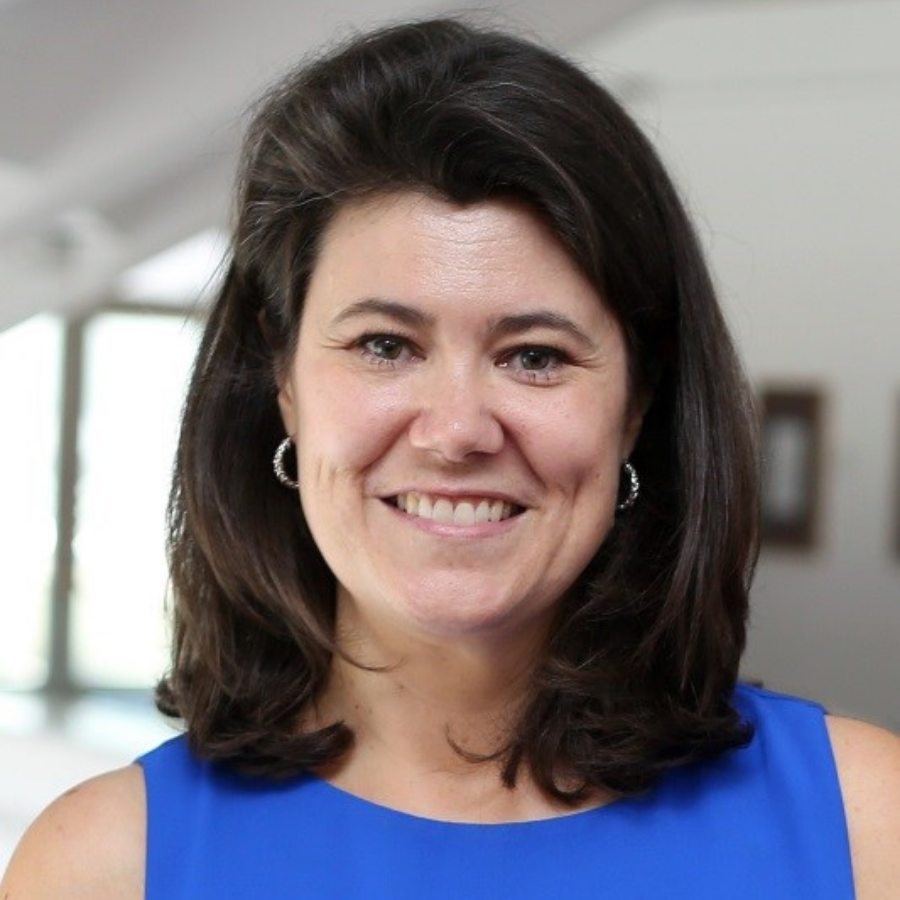
To explore these questions, Peace Leadership Collaborative team member sylvia murray joined in conversation with Julia Roig, Founder and Chief Network Weaver of the Horizons Project and a leader in ecosystem-based organizing. In this conversation, Julia reflects on what it means to cultivate collective power in a time when many feel overwhelmed, fragmented, or unsure where to begin. She offers a grounded, candid perspective on the importance and work of systems-level organizing, the risks and possibilities facing democracy movements in today’s global climate, practices for holding tension and strengthening collaboration, and a vision for our collective work ahead. What emerges is an invitation to shift mindsets, to invest in relationships, and to rediscover the shared work of building peace as a collective, living practice.
Julia reminds us that collective action is not built through perfect alignment or singular strategies; it is built through the ongoing, imperfect work of staying in relationship across tensions, across differences, and across time. She invites us to reorient from isolation to interdependence, from urgency to intentionality, and from certainty to shared sensemaking.
The call for collective power has become both more urgent and more elusive. Our work lies in embracing a “both/and” reality, as Julia offers – resisting harm and building what we are for, honoring lived experience and imagining new futures, standing firm in our commitments and remaining open to each other. When we ground in the collective, and collective power becomes a way of being, the possibility of collective peace becomes imaginable and attainable, together.
sylvia: How would you characterize the current moment for pro-democracy and peacebuilding movements in the United States? What opportunities and risks do you see for collective action right now? And how are you in this work and in this moment personally?
Julia: Things are heavy right now, so I feel heavy. We keep getting worse and worse news. My read on the moment – and also where people are, the response, the state of the movement – is that the majority of folks are probably trying to figure out what in the world to do and how to react. It just feels very overwhelming.
Then there’s a lot of people who maybe aren’t even paying attention. That’s weird to say, because my whole world is the people who are paying too much attention – and sometimes when people are paying too much attention, we’re in this urgency stress response – so I’m kind of shocked by how many people are not paying enough attention. Why are we not in the streets? Where is the mobilization muscle?
We are going to build it back up. It’s happening, but it’s happening slower because I think people are just dazed. That’s my general sense. The overwhelm of living under this type of government is real. We just got done with No Kings. We’re focusing on so many things at the same time, that with what’s happening in Iran I think it’s hard to grasp what to do other than call your senator or your representative. I have a lot of grace for where people are in this country, because I think that we haven’t had to practice these muscles for a while.
sylvia: If you could expand on that – what do you see as the opportunities and risks for collective action right now?
Julia: The risk that we have is we’re too diffuse, right? It’s a challenge that we have – the “everywhere, all at once” feeling. The risk is in continuing to be really siloed, either in our issue area, or not making the connection between the militarization of our government’s response internationally to the militarization domestically. What’s happening with ICE, going to the strongman solutions, to what’s happening internationally. I think sometimes we have a hard time making that connection to domestic policy. It’s not just about affordability – it’s getting used to guns on our streets and all of the things that we’re being asked to normalize. And because this is happening far away, and we have the benefit of being able to say what we’re most worried about is gas prices as opposed to the loss of life, getting people to pay attention to a thing right now is really the challenge and the opportunity.
So, connecting dots is the opportunity. And for folks to feel more powerful than they think they are, and to remember that all of this is being done in our name. It’s not being done to us. And that’s a pivot that we need to make.
sylvia: That brings me to your work at the Horizons Project. I’ve heard the Horizons Project described as “connective tissue” across movements. I’m curious, what does collective power look like in this ecosystem approach? How is it different from a traditional style of coalition building?
Julia: It’s hard to describe it and not sound too jargony. I’m a huge fan of ecosystem or systems-level thinking and organizing. So, what that means – the U.S. is vast. We are a huge country – it’s a huge system of actors and people and institutions. How could you pretend to be connective tissue if you don’t think of it as a complex system?
The approach that we take, when we think about building connective tissue strategically – [we think of] the concept of pillars of support, so sectors in society that can either prop up an unjust authoritarian regime or incentivize pro-democracy behaviors of our leaders and institutions. Those sectors of society become the way that we think about organizing – within veterans groups and faith organizations and networks, labor unions, businesses, youth organizations, arts and culture. We organize within those pillars as a slice of the ecosystem.
You get a lot of ideological diversity within each of those pillars, and [we need to] ensure that what we’re doing is not just progressive organizing, but cross-ideological. It does feel different from a coalition that comes together around a specific issue. Instead, it centers on people’s “stacked identities” – as a small business owner, a union leader, or a youth activist – and then how they’re shaping and wielding their own power within the pillar, and collectively across pillars. We hold space for the formation of a ‘Big Tent’ that is across pillars to think about how we incentivize shifts in loyalty away from an authoritarian regime, and incentivize pro-democracy behaviors and support.
“Connecting dots is the opportunity. And for folks to feel more powerful than they think they are, and to remember that all of this is being done in our name. It’s not being done to us. And that’s a pivot that we need to make.”
sylvia: I’ve also seen the Horizons Project use the language of ‘big tent organizing’ with all these sectors. It’s so many layers of identities and systems to be connecting – how do you balance inclusivity with maintaining strategic coherence, while trying not to lose the clarity or the effectiveness that is needed to meet this moment?
Jula: Interestingly enough, I think not trying so much for strategic coherence is helpful. That’s hard to sit with, you know, the emergence that happens with regards to commitment to relational infrastructure, but also then sharing strategic frameworks. We share frameworks around how to make political violence backfire, for example, or strategic non-violent action or non-compliance – all of the different tools that we have available to us. And so we are grounded in frameworks of how to think about this moment.
When you bring people together, there is a political education moment, and then there’s a grounding in what people are already working on. We’re not starting with “oh, we all need to focus on our election integrity.” The focus emerges from the group where there are pockets of very natural, organic overlap of interests. It’s very embedded within a way of thinking about systems-level organizing – you have the green shoots of collaboration that spring up that you connect, but the coherence is not the starting point. Little by little you are getting to know each other, because there’s diverse perspectives, constituencies, organizing models, mindsets, parameters, and then also experiences of the harm of what is actually happening.
I think if you are looking for coherence, you’re flattening all of that too much. Which is why it feels so different to be in a space where you’re allowed to just follow your energy and the energy of those around you, and then, maybe this other thing is happening on the other side of the formation. You might really want to be spending your time on training up your people, or communicating about courage, or thinking about economic justice and people’s lived economic pain right now. Or you’re really fired up about the invocation of the Insurrection Act and you want people to get ready for that.
There are so many things to be doing that we do have to prioritize and say, okay, well, here’s three working groups. But the working groups are really an excuse to be practicing a collective action muscle. This is, over the long term, the work that we’re doing.
sylvia: I’m curious if you could share more about when the Horizons Project started. How did you meet people where they’re at and what did you notice? How did you cultivate trust, grounding, and some sense of alignment to flex that muscle of collective action?
Julia: We got some really wonderful advice from John Paul Lederach really early on in this work. He loves his insect metaphors. If you think of ecosystem organizing or weaving work, he would use the metaphor of a spider going to a particular group hearing what they’re talking about, where’s their energy – maybe you plant a little seed of something you’ve heard from a different group, but you are not convening. You’re going to where they are, and attending their meetings and trying to be in service of their goals. Then you go and you participate in another group. You’re spinning the web behind you. For the first couple of years the Horizons team was mostly attending other people’s meetings, showing up as good partners to connect with them, to connect them to each other, and to connect them to educational resources.
We really did spend a lot of time on recognizing the authoritarian threat – how does the authoritarian playbook work? There was an educational element to that. Then when Erica Chenoweth and Zoe Marks came out with their paper on United Front Organizing in 2022, we did convene a meeting with organizers and bridge builders to talk about the need for United Front Organizing. It was educational, and it was also folks getting to know each other. It was just the beginning of talking about pillars as a framework. Talking about backfire, how to make political violence and threats and intimidation backfire. We really did spend the next couple of years intentionally showing up in pillar-specific spaces.
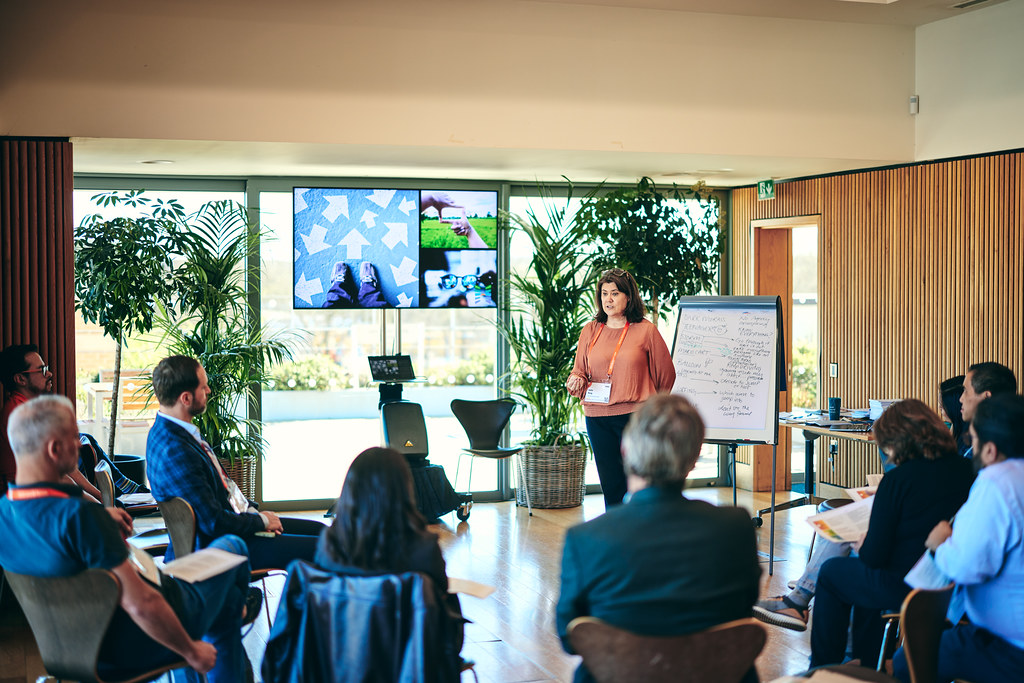
Then in 2025, when the second term of the current administration unfolded, we were in a position to be able to be a convener of a Big Tent formation. It was because we had spent a lot of time, like you say, meeting people where they are – having salons, doing webinars, writing lots of articles, offering some of the frameworks, doing a lot of intermestic (that’s international domestic) exchanges. Most of the Horizons team, including Maria Stephan and I, come from the international space and have helpful international connections. So, for example, in the business pillar specifically, it’s really helpful to have colleagues from Poland, Germany, Hungary, Brazil, or India share with U.S. business leaders, ‘we thought we were going to be okay and that we were going to be able to negotiate with the autocrat, and little by little, our economies have really suffered, and then crony capitalism takes over.’
My main point is we didn’t start by thinking we were going to be convening. We come to it with a lot of humility. When we first brought the group together in April of last year, that was this cross-pillar formation. We said we don’t know if this group wants to meet again, we don’t know if we’re the right ones to keep facilitating, but we were kind of legitimized in that moment. And we’re not the only ones who are doing this kind of work. There’s a lot of other folks doing it, so then there’s a whole constellation of other ‘big tents’, and we’re very conscientious of being in right relationship with those groups as well, supporting them, being in close touch so we all know who we’re organizing and what’s coming out of the different groups.
sylvia: What advice do you have for folks who maybe need support to open to the collective, that constellation, more? What have you learned in seeing the constellation, knowing all of us have a role – what is a lesson or two that you would share?
Julia: It doesn’t take as much as we think it does, and I see it more as a mindset shift. I love Adam Kahane‘s work of the everyday habits for transforming systems – what are you actually doing every day that it will occur to you, “oh, I should share this with these groups?” In the early days when I would introduce Horizons as an ecosystem-level organizer, I did have a person tell me from one group, “I don’t care about the ecosystem that much.” Meaning, I’ve found my lane, I’m going to do my job in my lane really well, and every time I get pulled into these ecosystem-level conversations, I find it distracting. I had a really big sticky note on my computer that said, “what if I don’t care about the ecosystem?” That reminded me some people are going to be doing a thing, and then there are others that will be organizing around them. I think part of it is just acknowledging that it’s okay to be in your lane. And we’re not really trained in this way of thinking about our collective work. We still have some sharp elbows. On the competition to collaboration spectrum, there’s a lot we still have to overcome, although I do see that’s getting a lot better.
It is about slowing down. I think when people have a stress response, and you feel the urgency of all of the things, then it’s hard to slow down for it to occur to you that you need to think about how you at least fit within the system. It doesn’t mean you have to change what you’re doing, but you’re aware. Especially if you could potentially be doing more harm than good by just continuing to keep doubling down on the work you’ve already been doing. I see a little bit of that, where it’s really hard to pivot to a new reality. So how do you even decide where and how to pivot? That’s a collective sense-making challenge.
Collective action is one thing, but to get to collective action, we need collective sense-making. What’s most needed? How should I be prioritizing? Should I keep doing what I’m doing? Maybe I shouldn’t anymore. Again, we’re not really trained for that – the collective sense-making. Who do we even talk to about what needs to be done? Who do we trust to be vulnerable enough, especially as leaders, to say, “yeah, this is crazy, I don’t even really know right now.” I think one of the stress responses we’re so drawn to is certainty, and that’s the exact wrong response sometimes.
“Collective action is one thing, but to get to collective action, we need collective sense-making.”
sylvia: Especially in moments of tension or internal conflict within movements, we so often see that when stakes and emotions are really high, it can easily cause fragmentation or tension. What are some tools or practices that you have used to strengthen collaboration and prevent fragmentation in ecosystem organizing?
Julia: With the amount of need that’s there, the urgency that we feel, the proximity to the harm as we were talking about – it sounds counterintuitive to slow down with people. And yet, I really feel like we have to calm our nervous systems to be able to find each other across whatever line of difference we’re trying to find each other across. Whether it’s geographic or generational or racial or religious. Our nervous systems are really driving our reactions.
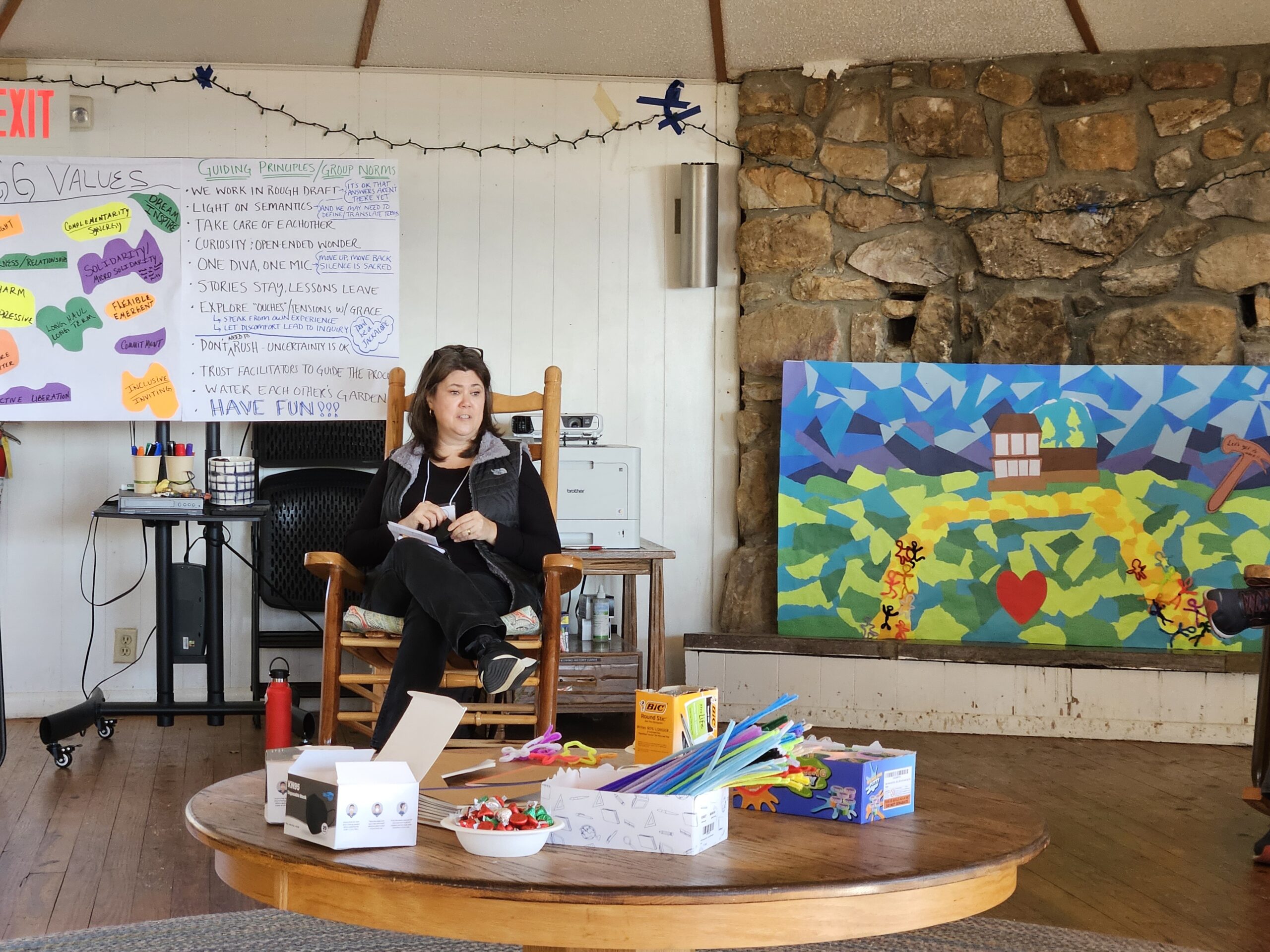
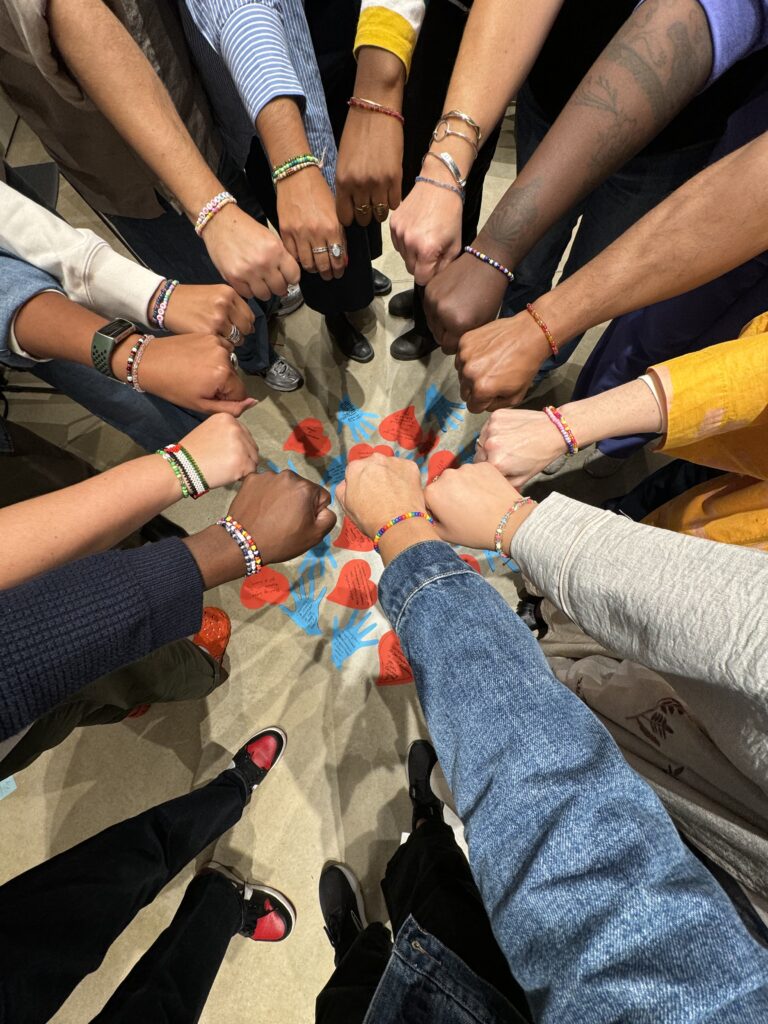
So then it’s making time for things like the funny facilitation things that people roll their eyes at. I’m super into laughing yoga. I’ll tell you, when I get a former admiral in the Navy who’s representing one of the vets groups he’s like, “we’re not gonna do that.” I’m like, “No, no, you are going to do this!” I kind of insist. Also, taking really long lunches when we gather, then asking people to take a partner walk. People within our field can be very transactional with each other, but the partner walks matter. I know it sounds like Captain Obvious stuff, but I’m telling you, what I see over and over again is people not prioritizing being human together.
When it comes to tensions, what I have found is there’s an artistry of knowing when to give attention to the conflict and the tensions, and when not to. It’s okay to feel uncomfortable sometimes. When people say the things that are on their hearts, and there’s tears, or somebody talks about the group hurting them and you can only hold so much within a certain space. Acknowledging that, from the person who’s holding the container, to say, “there’s so much that we are all holding.” If there’s an “ouch”, we have to trust each other, and we have to practice.
So I do tiny educationals, like half an hour within a facilitated retreat, of having a difficult conversation. How do you have a difficult conversation? Let’s practice. What is your solidarity love language? How do you like to give solidarity? How do you like to receive solidarity? People are sharing, and then you know that this person actually needs something different from me, and that the commitment is to stay together through the tensions.
Then you model. Say “okay, we just had an uncomfortable moment.” It doesn’t mean we’re going to stop and have a healing circle, actually. We’re going to keep going because we trust the group to be able to hold this, and then there’s the side conversations of checking in on how people are doing. Sometimes what I’ve seen is people who have studied conflict resolution want to jump into it a little bit too much. It can be okay to just let the tense moment happen and then we keep going. It’s not about sweeping things under the rug, it’s what the group can hold or doesn’t, or shouldn’t be asked to hold because then there’s other spaces that are the healing spaces, and not all of the collective action efforts have to be healing spaces.
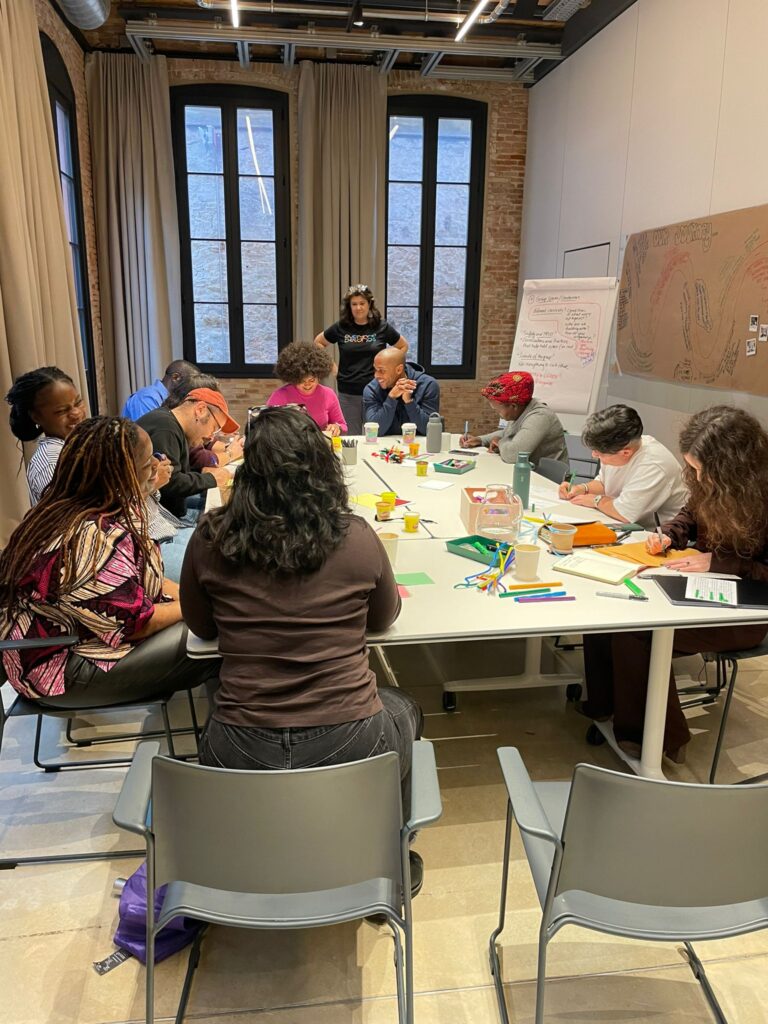
“How do you have a difficult conversation? Let’s practice. What is your solidarity love language? How do you like to give solidarity? How do you like to receive solidarity?”
sylvia: What lessons from international contexts are most relevant for building collective power specifically in the U.S. today? You mentioned colleagues in other countries coming together to share their context and what can be learned, so I’m curious if you could expand on that and where you see opportunities to cultivate more global solidarity together?
Julia: We’re about to host the World Cup, then we’re going to have elections, then we’re going to host the Olympics, then we’re going to have elections again. That’s exactly the experience Brazil had. There’s so much to learn from Brazil, and what they would have done differently.
There’s so much to learn – the strategic discipline, the durability of movements over the long haul. Even in our own history, if you think about civil rights, to get to the Montgomery bus boycott was more than 10 years of organizing and training. I think we do have to have grace for ourselves that we feel like there’s a short-term imperative, because the pace of our authoritarian consolidation has been faster than any other country in the world. This is an actual studied fact. And we still need to have the long-term perspective that we’re not organizing around any one election. We’re not going to vote our way out of this problem. It’s a shared struggle of humanity right now. So, to a certain extent, the lessons that I would bring from my work have been the power of investing in relational infrastructure over the long term.
I also acknowledge that we’re kind of in a new moment, that we’re feeling our way forward. There’s a challenge of what humanity is facing right now. The authoritarian resurgence, extremism and extremist movements, and regressive policies – whether it’s climate or privacy laws, women’s rights, all of the things – we are organizing within a new context and new levels of complexity. Therefore, I do feel like we can learn from what we’ve done in the past, but we’re also feeling our way towards a new future.
So of course, being in conversation with our Brazilian colleagues, with folks from Hungary, judges from Poland that actually took to the streets should be inspiring to judges here. Countries who want to say to us, “you are not exceptional, and we felt like we were immune, too, and we weren’t. We wish we had done this sooner, and you guys are in a moment right now that you should be doing it.”
But it’s not even American exceptionalism, it’s just I think our brains assume that the way things have gone in the past is the way things will go in the future. So I do believe that the future’s thinking work is something that is really imperative for all of us right now, not necessarily just scenario planning or scanning, but the ability to project ourselves out into a future that we need to reimagine completely. So then lessons of the past can only help us so much.
sylvia: To your point of both-and language, it is a huge both-and.
Julia: That’s right. Because, also what I’ll say is, one of my biggest lessons is in the U.S. context of [people] thinking that there isn’t a historic through-line to our current authoritarianism. People have been organizing under conditions of state violence and repression for generations. And so, we’re a little late to the party – folks who all of a sudden are like, “oh my god, the sky is falling.” There’s a lot to be learning from our colleagues who have been operating under racialized authoritarianism in the U.S for as long as they can remember.
sylvia: Absolutely. So, to move us to this living into the future – what is your vision for this thriving, interconnected ecosystem and what shifts need to happen to get there? Be it in leadership, in funding, etc, to make collective peace a sustained reality, rather than a moment?
Julia: Right now we – [the broader ecosystem and society] – are very much in a “no” posture. We’re focused on what we’re against collectively. Folks that are overly focused on institutional reforms, democratic reforms, perhaps are not paying attention to the threats enough. So, to a certain extent, we know what we don’t want, and we’re organizing against that right now. I think there will be a pivot and a joining of efforts to be more of a “yes” formation, or a yes coalition – what do we want?
There’s a whole bunch of research now – Frameworks Institute on cultural mindsets and others – that really demonstrate we are ready for big changes in the United States, whether it’s the Supreme Court, whether it’s the two-party system. You could just imagine us catapulting to a new future of how our systems of governance are run. I think that’s exciting, and I could imagine a shift of the ecosystem from this civil resistance posture to what we’re building and what we’re for.
What I really hope we don’t forget, and the U.S. is bad at this, is that there’s going to be a huge need for a reconciliation process. Truth and justice and accountability at the state level, at the national level – we absolutely will need our own truth and reconciliation process. That’s going to be hard for politicians because we’re really good at sweeping things under the rug, and we’re going to have to go all the way back [in history].
People are talking about it now with ICE – I know Minneapolis has a process, L.A. is talking about it, the state of Illinois – being really conscientious about the human rights abuses of ICE. But that can’t be divorced from the historic repair and reparations from slavery and, all Black and Indigenous reparation and solidarity processes. I know that sounds like a big ask, but until we heal as a society, we won’t be able to move forward. I’ll be very committed to that in the next decade, politically and as ecosystem organizing.
“…there’s going to be a huge need for a reconciliation process. Truth and justice and accountability at the state level, at the national level…that can’t be divorced from the historic repair and reparations from slavery and, all Black and Indigenous reparation and solidarity processes.”
sylvia: What gives you courage and what uplifts your heart in this work for the collective, for collective action, towards collective peace?
Julia: I feel really grounded and I probably feel very grounded because I’ve learned from so many people from overseas. I had the privilege of working with peacebuilders and activists from 50 countries. And I think back to what we used to ask of them to do in their own context, and think “oh my god, it’s so hard in your own country.” So I stand on the shoulders of my own elders and the people that I learned from, like Raymond Shonholtz, one of the founders of the mediation movement in the United States.
But then, I’ve got to tell you, what really helps is to not forget that joy is resistance. Sounds so trite and it is so true. I was meant to live in the age of TikTok, and I love to make silly dancing videos with people. It gives me an insane amount of joy – we make very silly videos at my events and I crack up and I love watching them and showing [them] to people afterwards. You can’t take yourself too seriously. We’ve got to remember to be silly. You can be serious, it’s not like you’re not taking the moment seriously, but remembering to enjoy each other as human beings and to laugh, that’s important to me.
We don’t have to do all the things alone. There’s a lot of people in the movement space that feel the weight of the world on their shoulders, and it’s not going to be any one of us that is going to make the change. We can step away and take care of ourselves and rely on other people. It’s important.
We all have to give each other grace right now, because all of the things that we’ve just been talking about are easier said than done sometimes. So then when we’re not our best selves, then it’s okay too, honestly.
“…remembering to enjoy each other as human beings and to laugh, that’s important to me.”